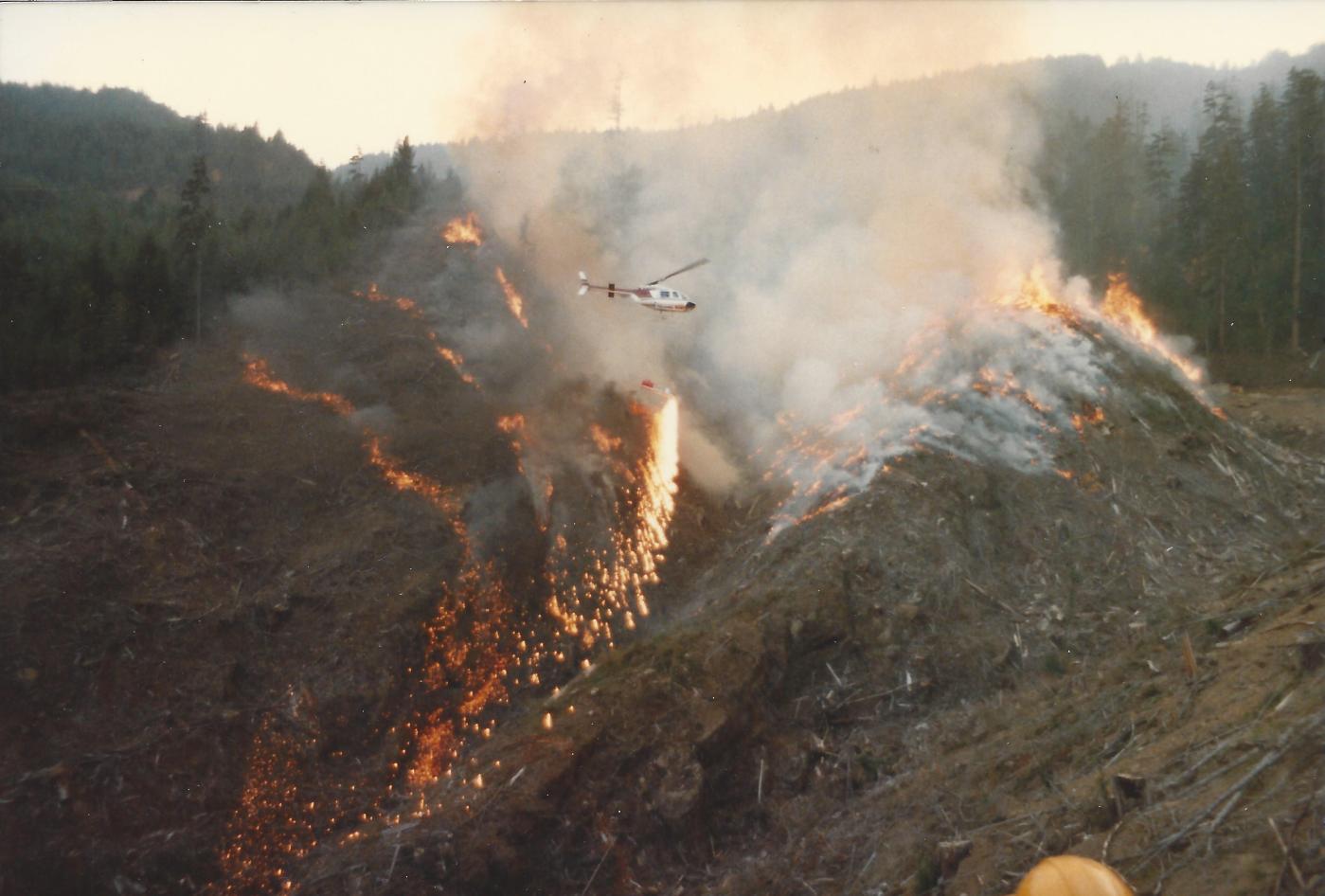
Sitting at the top of the unit, and things are pretty boring. Holding boss is always slow; we’ve got this prescribed fire thing down pretty good and major blowouts are fading in our corporate conscience. Today is going to be about as boring as burning can be.
So I sit and wait, then wander along the road to the other upper corner of the unit. The heat builds, the column roils then rises; heavy heat and smoke blowing across the road. Bored, but uneasy a bit; I don’t like being away from my tools and evac kit, so I start a quick shuffle back, hugging the cutbank and looking for the clear air near the ground.
Radio speaks, “got somebody down in the unit; need the evac kit.” Simple words, but back of my mind chants “bad, bad; somebody’s down and dead.” Where does this sense come from? How do you know? Words, tone of voice? Or is it something psychic when good things go bad—why do you sometimes know what you cannot know? My average fire-alertness is knifed to a new level; adrenaline pours.
No longer at a lackadaisical shuffle, it’s a hustle and into my rig. Onto the radio–“need an ambulance?” “Yes” comes back the reply, and the system we’d worked on so long comes into play. A word to dispatch and an ambulance is en route to the rendezvous point; one of our folks already on the roll to meet it and navigate in. Western Oregon is a maze of logging roads, radio dead spots, and slim medical resources—everything is against us….
Straight line, it’s not far through the unit to the bottom—and if the unit wasn’t a sea of flame I could be there in a few minutes. But it’s two miles by road; the mountains are steep and it is switchback city to get down there.
Dave on the radio, “fire’s near the victim; we gotta move!” Back I come: “Do what you have to; move as a unit and protect the spine”. Good folks down there; none better and sooner or later you have to trust someone.
Soon enough and yet too long I get to the bottom. Some loggers hustle down to the landing, grab my gear while I hustle, lungs heaving, up the hill to the crumpled yellow shirt. Then I understand why the weird tone when Dave called. He’s not dead. Matter of fact, its not he, period. Its Carol.
Sure, we’re all equal; sure, we don’t notice sex in the Federal service, but Carol’s sorta everybody’s sweetheart anyway. She’s a good hand, hard worker, sharp mind, and manages to be as feminine as she is absolutely reliable. She’s “us” in the best of ways and still wholly woman in a wildly man’s world back then. And she’s hurting. Agony. Huge rolling rootwad, probably two tons of insensate tree carcass, hurtled out of the smoke and ran the crap right over her, no warning.
Later we’ll know the list: 5 rib fx posterior; 3 rib fx anterior; collapsed lung, bilateral dislocation of the clavicle. Etc. But now all we know is this is a desperate mess, 50 miles from a hospital. 30 miles of dirt road. Helicopters: none.
But the routine begins, and for once it is a routine. You’ve drilled for this one forever it seems, and everything just flows; a rescue ballet staged in Dante’s inferno.
All the gadgets go on; immobilized; SKED stretcher works like a charm; O2 cranked up and down the hill. Just time for another set of vitals and the ambulance rolls up. Out leaps the medic; his eyebrows pop up as he discovers his patient already packaged and waiting–he sees you’ve got it in hand and wastes little time before you’re in the rig. Not too much to do right off; got about everything done that you can. A few quiet minutes, she’s hurting and that’s that. Down the hill—miles and miles of hills–and onto the asphalt; crank on the knots for the 20 mile run to town. Not much changes and it’s only unusual because it’s a friend and you’re holding her hand because there’s not much else to do; nothing left in your limited bag of tricks. In Oregon, in rural Oregon, advanced life support was barely a pipe dream. And then.
Her respirations deepen; talk stops; rough, burbling, every breath a labored stretch for air and things are going gunnysack fast—her jagged fractured ribs have taken one lung out and now the other is being submerged in blood. Far from the nearest drop of water, she is drowning. Dying. Seconds tick.
And sad fact is, we’ve used up every trick in our EMT trade; I pretend to keep doing something, but the last ten or so I’m just holding her hand and praying; if she’s aware of anything she’s aware that the precipice is at her feet…. We’re just off the freeway and 5 minutes out; “take us home” I urge the driver and he knows all’s not well. We back into the ER and I’m counting the seconds to a code; this is not good/not good/not good/drag her out of the rig and we’re swamped by the ER crew; they’re all clean and you’re oddly aware of your sweat-reeking, filthy Nomex and really, truly, such a sweaty, foul soul shouldn’t be in the ER…. But somehow I’m swept along with the crowd, into the trauma room….
Onto the table and the doc is flying; a medical maestro at frenetic tempo. Never have I seen so many things happen at once, and suddenly he’s handing me a tube saying “hold this.” My eyes trace the tube from my hand down, down, down to where the doc is digging at her side; slicing between the ribs and sliding in the tube…in goes the tube; Carol arches; gasping too much to scream…. In goes the tube and out goes the blood; a gushing flood that spatters indiscriminately. It is primal magic. The blood is going, gone; the air is coming, flowing in…. Pain explodes even as the relief of breath surges; she can breathe and even as she grimaces and clenches briefly my hand; she knows.
She’ll live. Three weeks in ICU. First week, they wouldn’t even let us see her. Finally they do; three of us shuffle in. Wan, weak beyond words but with the fire of life in her eye, she catches my eye and says but five words:
“Thanks for holding my hand….”
A few more words among us, then off we shuffle. But those five words have never left, and never should. For if any of us are human; if any humane; we should never forget to each in our own way hold one another’s hand.
God it was close, so close…
 Westwander
Leave a comment